


Creatine Monohydrate: 30 Years of Research, Zero BS
What 1,000+ studies actually say about creatine — the dose, the mechanism, who needs it, and why most people quit before it works.
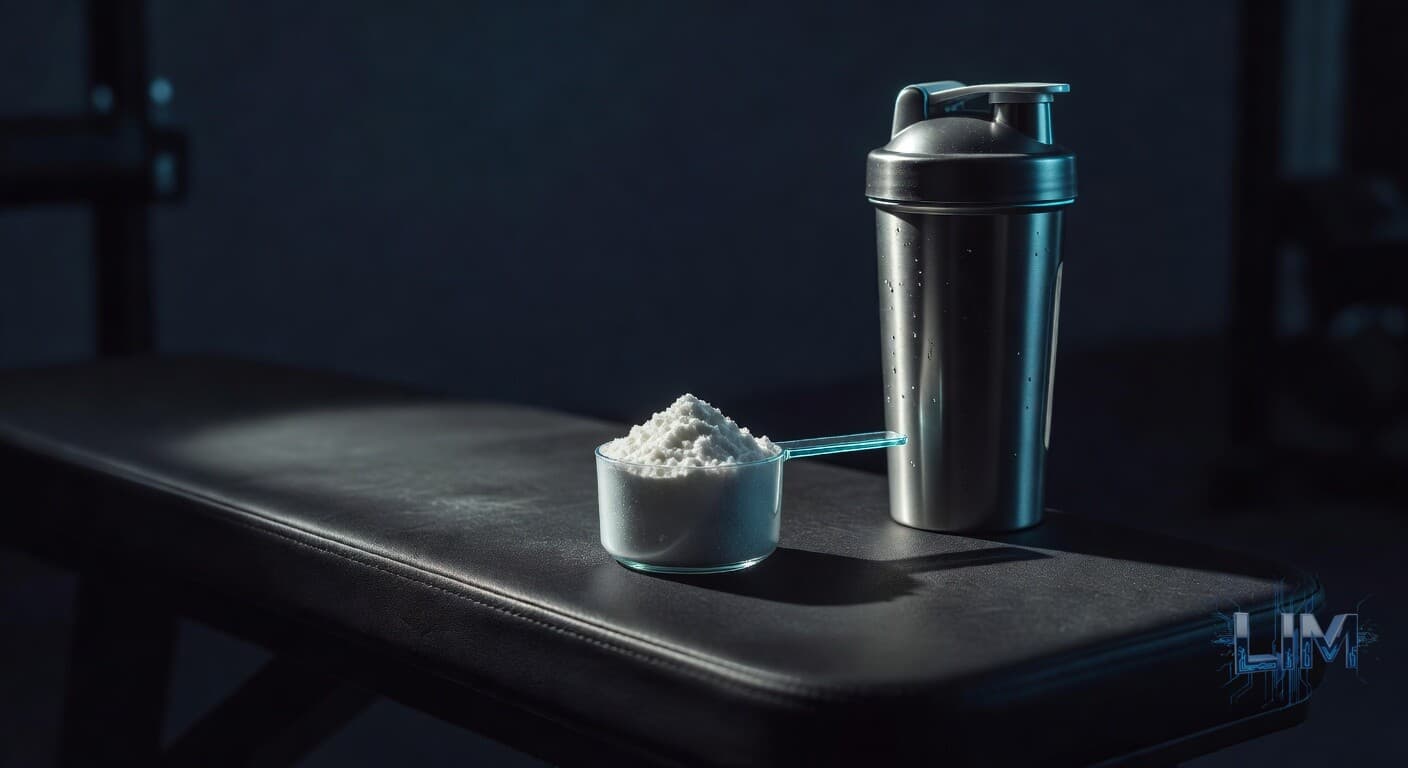
It's 2:47 AM in the hospital security office. Marcus, 41, two kids, second graveyard shift this week, has been hitting the gym hard for four months and his bench has not moved a single pound. He's eating clean. He's sleeping when he can. He's frustrated enough to text his coach mid-shift: "Am I just too old for this?"
He's not too old. He's missing five grams of the most-studied legal performance compound on Earth. And before you scroll past — yes, this is the creatine article. Stay with me.
TL;DR - Creatine monohydrate is the most researched legal ergogenic aid on the planet — over 1,000 peer-reviewed studies since the early 1990s. - 5 g/day, every day, no loading needed. Saturation hits at 3–4 weeks. - Meta-analysis: 5–15% bumps in strength and power (Kreider et al., JISSN 2017). - 1–2 kg lean mass over 8–12 weeks with resistance training (Volek et al., 1999). - It also crosses the blood-brain barrier and protects cognition during sleep deprivation (Rae et al., 2003).
Why Marcus's Bench Won't Move
Marcus is doing everything right except the math on his ATP system.
Every rep past about #6 is bottlenecked by how fast your muscles can regenerate ATP — the literal currency of muscle contraction. Creatine phosphate is the donor that refills the tank between reps. Empty tank, stalled bench.
Related Read
3g Glycine, 60 Minutes OutCreatine doesn't build muscle. It buys you the reps that build muscle.
Your liver and kidneys make 1–2 g a day from glycine, arginine, and methionine. You eat another gram or two if you actually cook meat. That's nowhere near saturation in a lifter's muscle (Kreider et al., 2017, JISSN).
The Number That Should End the Argument
Kreider's 2017 meta-analysis — the one most coaches quote and most influencers misquote — pooled hundreds of trials and found 5–15% increases in maximal strength and 5–15% increases in power output in trained subjects.
A 41-year-old shift worker leaves a 10% strength bump on the table because the powder isn't sexy.
Add Volek et al. 1999: 1–2 kg of lean mass in 8–12 weeks when paired with resistance training. That's not water. That's volume tolerance translated into actual tissue.
And the part nobody markets — Rae et al. 2003 showed creatine crosses the blood-brain barrier and measurably protects cognitive function under sleep deprivation. If you've ever driven home from a 12-hour night shift, you know the value of that.
The Dose Is Boring on Purpose
Five grams. Every day. Forever. Mixed into water, coffee, your shake, whatever.
No loading phase. The 20 g/day-for-a-week protocol exists in old papers because researchers needed fast saturation for short studies — not because your body needs it. Same endpoint at 3–4 weeks on 5 g/day, for $15–25 a month.
If a supplement protocol fits on a sticky note, that's a feature, not a bug.
Skip the "advanced" forms. Buffered creatine, ethyl ester, liquid — none of them beat plain monohydrate in head-to-head research (Kreider et al., 2017). Buy the boring tub. Get the NSF Certified for Sport or Informed Choice stamp. Done.
Drink an extra 500–1000 mL of water — creatine pulls water into the muscle cell, that's basic osmosis, not a side effect.
Why Marcus Quit at Week Three Last Time
Here's the dirty secret of creatine compliance — and the part 30 years of research doesn't fix for you.
Week one, you bloat two pounds of intramuscular water. Week two, the scale won't move. Week three, you forget it on Saturday, then Sunday, then it's been a week. Week four — when the actual strength curve kicks in — you've already quit.
The supplement works. Human consistency at 2 AM after a 12-hour shift does not. I know because I lived it. At 308 pounds on hospital security graveyards, knowing something was good for me did not get it into my bloodstream.
This is the kind of pattern Chiron — our AI head coach inside Legacy In Motion — flags in the daily program review. If your bench has stalled three weeks despite clean training volume, Chiron isn't going to tell you to "try harder." It checks your protein log, your sleep score from HealthKit, and whether you've actually taken the basics. The voice-note check-in catches the cortisol-tell in your voice before the scale moves.
When your Apple Watch logs sub-6 hours of sleep three nights in a row, the daily AI program update worker rewrites your week — pulls the heavy bench, swaps in tempo work, and pings you to take the damn creatine.
What Creatine Won't Fix
It will not fix garbage sleep. It will not fix a 90 g/day protein intake when you need 160. It will not undo the cortisol bath of three back-to-back overnights with no decompression.
It also will not — and this part matters because the internet is full of nonsense — damage healthy kidneys, convert to DHT, or shut down your natural testosterone. Multiple long-term trials, no signal (Kreider et al., 2017).
It is the cheapest, most-evidenced, most-boring weapon against sarcopenia after 35. Use it.
For Marcus, the move is five grams a day, three more weeks of the same training block, and a system that actually tracks whether the powder hit the water. He texted back two months later: bench up 25 pounds, body weight down four. That's not magic. That's the math working when somebody finally let it run.
The Inevitable Part
You can keep reading creatine articles. Or you can put the science on autopilot — daily protocol, voice-note check-ins, AI coach that scrapes 12,000 fitness papers a week so your protocol updates the second the evidence does.
If you're the kind of person who reads to the bottom of a study and actually wants the protocol installed in your life, we built Legacy In Motion for you.
---
Coaching that works the same shifts you do
Chiron, our AI head coach, coaches the week you actually have: overnights, doubles, rotation flips, kid pickups. Log the change and tomorrow's plan already knows. No static program that assumes you sleep at 10pm and train at 6.
$29.99/month · $249.99/year · 7-day free trial · cancel anytime · no enrollment fee · no contract
Start coaching → · See the full app →
Jake Long built it after losing 112 lbs working hospital night shifts — when no human coach could keep up with his schedule. He wanted the system he wished he'd had at 308. Now you can use it too.
Comments (0)
Comments are reserved for Legacy In Motion members.
$29.99/month. No contracts. Cancel anytime.
Get StartedAlready a member? Sign in
You read this far. Now do this.
You've read the theory.
Now put it to work in your real week.
I went from 308 to 196 lbs working 12-hour overnight shifts with two kids and zero personal trainer. The system I used is now an app that plans your training and meals around YOUR schedule — overnight, day shift, all of it.
Cancel anytime · No setup fee · No long contract
Free Assessment
What's Really Stopping Your Progress?
Take our 60-second quiz and get a personalized breakdown of what's stopping your progress — plus how AI coaching solves it.
Take the QuizFree PDF · No Credit Card
Get the Shift Worker AI Fitness Blueprint
A 4-week plan that respects what shift work does to sleep: when to go down after a night, the four-minute REHIT window, post-shift macros, and when to back off. In your inbox in 30 seconds.
Built by someone who actually worked them. No fluff. Unsubscribe any time.
Keep Reading
2026-04-20
3g Glycine, 60 Minutes Out
2026-07-21
Night Shift Meal Timing: Why Breakfast After Nights Fails
Delayed eating windows—not classic 16:8—improve next-day glucose handling for rotating nurses. Build a meal clock from your roster, not the wall clock.
2026-07-13
MRT for Busy Parents Over 40: Strength + Burn in 25 Minutes
Metabolic resistance training (MRT) is the 2026 busy-parent default: compound strength circuits with short rest that build muscle and raise the metabolic cost of a short session. How over-40 adults and desk workers run it without wrecking recovery.
Join our free fitness community — get coaching tips, share wins, and stay accountable.
JOIN THE DISCORD →