


Your Pharmacy Went Dark. The Next 72 Hours Decide the Body on the Other Side.
The FDA enforcement window on compounded GLP-1s is closing. The 60-to-90 day gap is a metabolism window, not a cliff. The six levers that hold the floor while you wait for the next molecule.
11:02 ET. Mark is 55. He is in his kitchen, second cup of coffee, scrolling a Reddit thread where 47 people in the last six hours have asked some version of the same question.
My pharmacy just told me they cannot ship the compound anymore. What do I do.
Mark started his cut at 287 last March. He is at 218 on the morning scale, was on his way to a number he had not seen since his daughter's wedding in 2018. His longtime coach — the one who has been programming around the bilateral knee replacements and the rotator cuff since 2024 — texts him every Sunday with the week ahead.
This morning the coach asked the question Mark had not wanted to think about.
Related Read
One Year Ago Today I Weighed 308: The Muscle-Loss Frame Just Got RewrittenOn May 21 2025 I stepped on a scale at 308 lbs. One year later — 196, 14.1% body fat, 168.7 lbs fat-free mass. The Cell Reports Medicine and ECO Istanbul May 2026 readout (n=486, mean age 49.9) just walked back the 20% lean-mass-loss panic that was internet conventional wisdom when I started. Here is what the new evidence changes, what it does not, and what the over-40 patient on the ride right now should do about it.
What is the plan for the gap.
Why this week specifically. Three news vectors stacking.
This is not a routine "the supply is tight" cycle. Three things are happening at once.
First, the FDA's enforcement on compounded GLP-1 outsourcing facilities is at the inflection point where 503B pharmacies stop shipping. The agency has been signaling this trajectory since the official "no longer in shortage" determinations on tirzepatide and semaglutide. The wholesale market that propped up 12 to 18 months of affordable access is closing.
Second, Stanford-led research published this month — the paper that is going to get cited in every peptide thread for the next five years — quantified what the lower tail of the GLP-1 trials had already suggested. A meaningful fraction of users, roughly 10%, were not getting the response the headline numbers promised. That is not "the drug stopped working." That is "the drug never worked for me, and I just spent eight months convinced I was the problem."
Third, the Eli Lilly TRIUMPH-1 retatrutide readout delivered a headline number, but the FDA path to general approval has its own timeline. A non-trivial dysesthesia signal at the 12 mg dose means the careful patient is not racing to be first in line.
The combined effect. A lot of people in the 50-pound-down cohort woke up this week without a refill on the horizon, without a tier-two molecule in pharmacies, and with a new paper telling them the original premise was less reliable than it sounded.
The 90-day gap is a metabolism window, not a cliff
The body's adaptation to a GLP-1 is not the same machinery as the body's adaptation to weight loss itself.
The receptor occupancy from the last semaglutide dose decays over roughly 14 to 28 days. The metabolic adaptation — the lower resting metabolic rate, the suppressed NEAT, the more efficient walking economy — does not decay on the same curve. That is the gap to manage.
The energy-expenditure literature is clean on this. Total daily energy burn drops faster than body-weight loss predicts, because the body downregulates non-exercise activity aggressively. The mechanism running in the post-peptide window is the same machinery documented in long-term weight-loss follow-up cohorts.
Mark's metabolism at 218 lbs is not the same metabolism a never-overweight 218-lb peer walks around with. That is the window.
The cliff is what happens when somebody treats the supply gap like a vacation, eats at perceived maintenance for three weeks, and watches the scale jump 12 to 18 lbs of mostly water and glycogen. Which then becomes mostly fat by week eight, because the surrounding training and protein protocol collapsed.
The 72-hour bridge protocol is the floor that prevents the cliff. Here is what is on it.
Six levers, held hard
This is not a 12-week plan. This is the first 72 hours of the gap, designed to install the habits that will hold for 60 to 90 days.
1. Recalculate maintenance from current weight, not starting weight
Mifflin-St Jeor with current weight. Activity factor 1.4 if you mostly sit, 1.55 if you train three to four times a week, 1.7 if you are on your feet for work.
That number is the new maintenance. Then sit at 10 to 15% below it during the gap, not the aggressive 20 to 25% you may have been at on-drug. Without appetite suppression you will not adhere to a steep deficit, and a missed deficit you tried for is psychologically more expensive than a smaller one you actually hit.
2. Leucine floor: 3 grams per meal, at least four meals per day
The most underrated lever in the gap. Muscle protein synthesis is stimulated when a meal clears the leucine threshold of roughly 2.5 to 3 grams. Below that, the meal contributes calories but does not maximally stimulate the synthesis machinery.
Four meals at 3 grams of leucine each is roughly 30 to 40 grams of complete protein per meal. About 8 oz of chicken, or 4 whole eggs plus a scoop of whey, or a 32 oz Greek yogurt bowl with collagen-stripped whey. Total daily protein lands at 1.8 to 2.4 g/kg of goal weight, not current weight.
Why this lever in the gap. Appetite suppression goes away when the drug clears. Protein satiety is the body's native version of the same signal. The leucine target is not just muscle-protective. It is appetite-protective.
3. Eccentric loading, three sessions a week, non-negotiable
Lifting heavy is not the only requirement. Eccentric-loaded training — the slow-lowering portion of every rep — produces a disproportionate hormonal and metabolic response per session relative to volume.
Even five-minute office-protocol eccentric bouts produced measurable strength and metabolic effects in deconditioned populations in the recent ECU work. The bridge-window version is the same protocol three times a week, paired with whatever resistance training you can keep on the calendar.
The point is not to crush yourself. The point is to give the body a clear reason to keep the muscle on.
4. Defend grip strength specifically
Buy a hand dynamometer for $30. Test once a week, dominant and non-dominant.
If grip drops by more than 5 to 10% during the gap, the rest of the protocol is not holding and the program needs adjustment that week, not in three.
The reason grip. It tracks systemic muscle and neurological status better than any single lift, it has minimum noise from technique drift, and the literature on grip-as-mortality-predictor in adults over 50 is among the cleanest in geriatric epidemiology.
5. Walking pace, not walking volume
The recent reframing of brisk walking as a stand-alone vital-sign-grade input is the version that matters here. The lever to defend is not "10,000 steps." The lever is "30 minutes at a pace where conversation gets choppy" — usually 105 to 120 steps per minute for most adults — at least five days a week.
That defends the NEAT-style cardiovascular tax the peptide-on protocol was already getting via appetite-driven lower intake. Without the appetite drop, the walking-pace requirement scales up, not down.
6. Sleep floor of seven hours, defended
The classic sleep-and-deficit work found that sleep below six hours cut fat loss by 55% compared to 8.5 hours on the same calorie deficit. Outside of a peptide, this lever is the most fragile and the most consequential.
Seven hours is the floor. Eight is the target. The bridge protocol does not survive without it.
What this looks like for the 308-to-196 patient
I came out of the gap between my two peptide phases at 196.4 lbs and 14.1% body fat, fat-free mass 168.7 lbs. The reason I came out of it there and not at 204 lbs and 17% body fat was the six levers above, held hard.
The honest part is that the gap was the hardest mental stretch of the entire 112-pound arc. Without the appetite suppression, every meal was a decision again. The training had to do work the drug used to do for free. The walks had to be paced, not just clocked. The grip dynamometer on the kitchen counter became the morning check-in I did not realize I needed.
The 60 to 90 day window is long enough to backslide visibly if the floor is not held. It is also long enough to install habits that survive the next molecule, the next supply disruption, and the eventual transition to maintenance without any peptide at all.
What to ask your doctor this week
Not medical advice. I am a patient who lost 112 lbs and watched the news cycle change three times, and a coach for a company built to track these levers. The conversation to have this week, in this order:
- What is the realistic timeline back to a manufacturer-grade molecule given current insurance and supply realities?
- What does the gap look like in weeks, not days? 30, 60, 90? Plan accordingly.
- If retatrutide becomes available in a clinical context I am eligible for, what is my candidacy given the TRIUMPH-1 dysesthesia signal at the 12 mg dose?
- If I am in the Stanford 10% non-responder cohort, what does the next 12 months look like outside the GLP-1 framework entirely?
What adaptive coaching adjusts for in the gap
The reason a peptide gap is brutal solo is that the program you were on while on-drug is not the right program off-drug.
The protein target changes. The training stimulus changes. The walking-pace requirement scales up. The sleep floor becomes load-bearing.
A program built to adapt is checking every week of the gap. Whether current weight is trending, whether grip strength held, whether sleep stayed above seven hours, whether the leucine floor was actually cleared four times a day. Then it moves the levers that need moving.
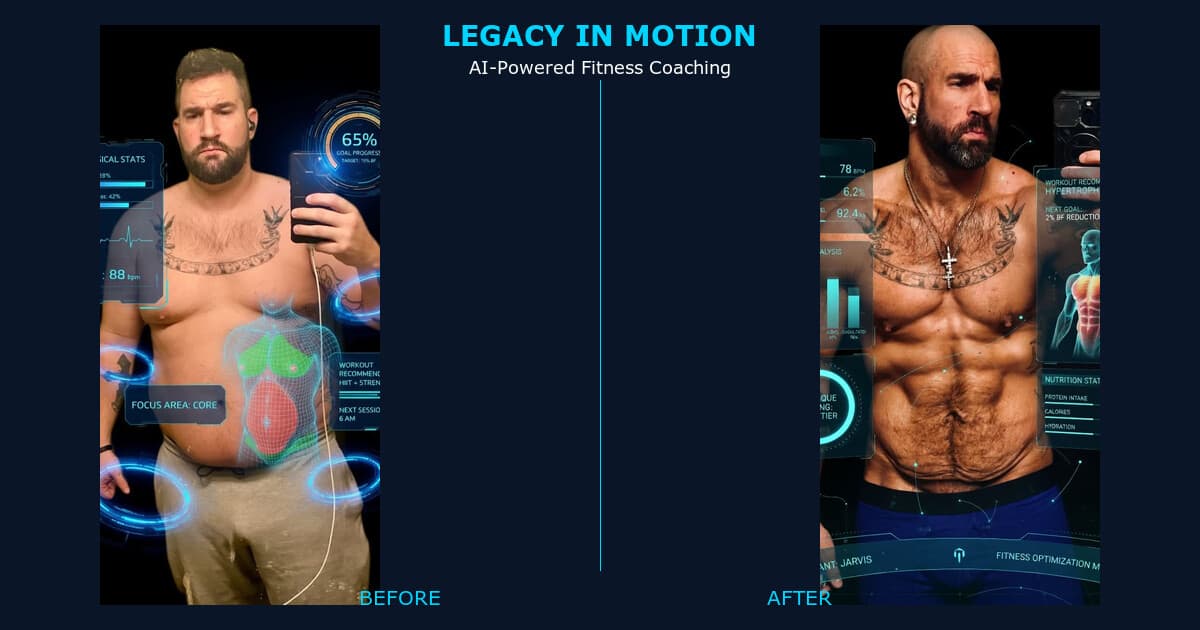
That recalculation loop is what we built into Legacy In Motion. The AI is not magic. It just does not forget that the body at 218 lbs in a peptide gap needs a different protocol than the body at 218 lbs three weeks back on-drug.
The floor
If your compounded semaglutide pharmacy went dark this week, the 72 hours ahead are not a crisis. They are the start of a 60 to 90 day window where the levers above either hold or they do not.
Recalculate maintenance from current weight. Hit the leucine floor four times a day. Lift eccentric three days a week. Defend grip strength. Walk at a pace that makes talking hard. Sleep seven hours, minimum.
That is the floor. The next molecule will arrive on its own timeline. The body at the other end of the gap will be the one you spent these 72 hours building.
— Jake
---
The data behind this
- FDA 503A and 503B enforcement on compounded GLP-1s, May 2026 — agency signaling on tirzepatide and semaglutide no-longer-in-shortage determinations.
- Stanford-led research, May 2026 — non-responder rate among GLP-1 users estimated at roughly 10% in the first 16 to 24 weeks of therapy.
- Wilding JPH et al. *NEJM.* 2021;384:989-1002 — STEP-1 semaglutide phase 3 readout; lower tail of the response curve sits below 5% loss at 68 weeks for a subset of participants.
- Jastreboff AM et al. *NEJM.* 2022;387:205-216 — SURMOUNT-1 tirzepatide phase 3 readout; same lower-tail pattern.
- Eli Lilly TRIUMPH-1 retatrutide readout, May 2026 — up to 71.2 lbs loss at 12 mg over 80 weeks; non-trivial dysesthesia signal at 12 mg dose.
- Pontzer H et al. *Cell Metabolism.* 2021 — total daily energy expenditure compensates downward when intake drops; mechanism running in the post-peptide window.
- Fothergill E et al. *Obesity.* 2016;24:1612-1619 — Biggest Loser follow-up; metabolic adaptation persists years after weight loss.
- Helms ER et al. *Journal of the International Society of Sports Nutrition.* 2014 — 1.8 to 2.4 g/kg goal-weight protein target for lean-mass-protected deficits.
- Bohannon RW. *Journal of Geriatric Physical Therapy.* 2019;42:71-72 — grip strength as a mortality vital sign in adults over 50.
- Nedeltcheva AV et al. *Annals of Internal Medicine.* 2010;153:435-441 — sleep below 6 hours cut fat loss by 55% versus 8.5 hours on matched deficits.
- Nosaka K and ECU group, *Journal of Sport and Health Science.* 2026 — short-bout eccentric protocols in deconditioned populations.
- Mayo Clinic Proceedings walking-pace work, 2026 — brisk walking as a stand-alone vital-sign-grade input distinct from total step count.
- Jake's own numbers: 308 → 196 in 9.5 months (started May 2025). Post-peptide-gap numbers in the body (196.4 lbs, 14.1% body fat, 168.7 lbs fat-free mass) are personal; protocol generalizes, individual outcomes vary.
Frequently Asked Questions
What happens if my compounded semaglutide pharmacy stops shipping?
Practically, you have a 14 to 28 day window where the receptor occupancy from your last dose decays toward baseline. The metabolic adaptation you built — lower NEAT, suppressed RMR — does not decay on the same curve. That gap is when regain accelerates if training stimulus, protein floor, and step count do not get defended.
What is the GLP-1 non-responder rate?
Stanford-led research published this month estimates roughly 10% of GLP-1 users never achieved clinically meaningful loss in their first 16 to 24 weeks of therapy. That figure aligns with the lower tail of the STEP-1 and SURMOUNT-1 trial curves, where a subset of participants sat at less than 5% loss at 68 to 72 weeks.
How do I protect lean mass in a GLP-1 supply gap?
Hit a leucine floor of 3 grams per meal across at least four meals per day — roughly 30 to 40 grams of complete protein per meal. Defend grip strength specifically. Bohannon framed grip as a mortality vital sign in adults over 50, and it is the easiest single biomarker to track at home.
Is retatrutide approved to fill the gap?
Not for general use. The TRIUMPH-1 readout reported up to 71.2 lbs loss at 12 mg over 80 weeks, but retatrutide is not FDA-approved for routine prescribing at the time of this post. Patients in the supply gap need a plan that assumes no peptide for 60 to 90 days.
Comments (0)
Comments are reserved for Legacy In Motion members.
$29.99/month. No contracts. Cancel anytime.
Get StartedAlready a member? Sign in
You read this far. Now do this.
Stop reading about it.
Start training around your real life.
I went from 308 to 196 lbs working 12-hour overnight shifts with two kids and zero personal trainer. The system I used is now an app that plans your training and meals around YOUR schedule — overnight, day shift, all of it.
Cancel anytime · No setup fee · No long contract
Free Assessment
What's Holding Your Fitness Back?
Take our 60-second quiz and get a personalized breakdown of what's stopping your progress — plus how AI coaching solves it.
Take the QuizFree PDF · No Credit Card
Get the Shift Worker AI Fitness Blueprint
The exact 4-week protocol Jake used to lose 112 lbs working hospital security overnights — sleep timing, the four-minute REHIT window, post-shift macros, and the AI deload trigger. Drops in your inbox in 30 seconds.
Built by someone who actually worked them. No fluff. Unsubscribe any time.
Keep Reading
2026-05-21
One Year Ago Today I Weighed 308: The Muscle-Loss Frame Just Got Rewritten
On May 21 2025 I stepped on a scale at 308 lbs. One year later — 196, 14.1% body fat, 168.7 lbs fat-free mass. The Cell Reports Medicine and ECO Istanbul May 2026 readout (n=486, mean age 49.9) just walked back the 20% lean-mass-loss panic that was internet conventional wisdom when I started. Here is what the new evidence changes, what it does not, and what the over-40 patient on the ride right now should do about it.
2026-04-26
Half a Rep, in the Right Half, Is the Whole Job
Stretched-position partials match or beat full ROM for hypertrophy in trained lifters. For the 50-year-old training around a rotator cuff, that's the highest yield per unit of recovery cost a body can buy.
2026-04-23
The Treadmill Counts. The 2016 Paper That Said Otherwise Just Got Buried.
Join our free fitness community — get coaching tips, share wins, and stay accountable.
JOIN THE DISCORD →