


Four Minutes Did Not Write Thursday
The four-minute strength headline on Thursday feeds is a March trial in adults 65 and older who already had trouble walking. It is not your session.
# Four Minutes Did Not Write Thursday
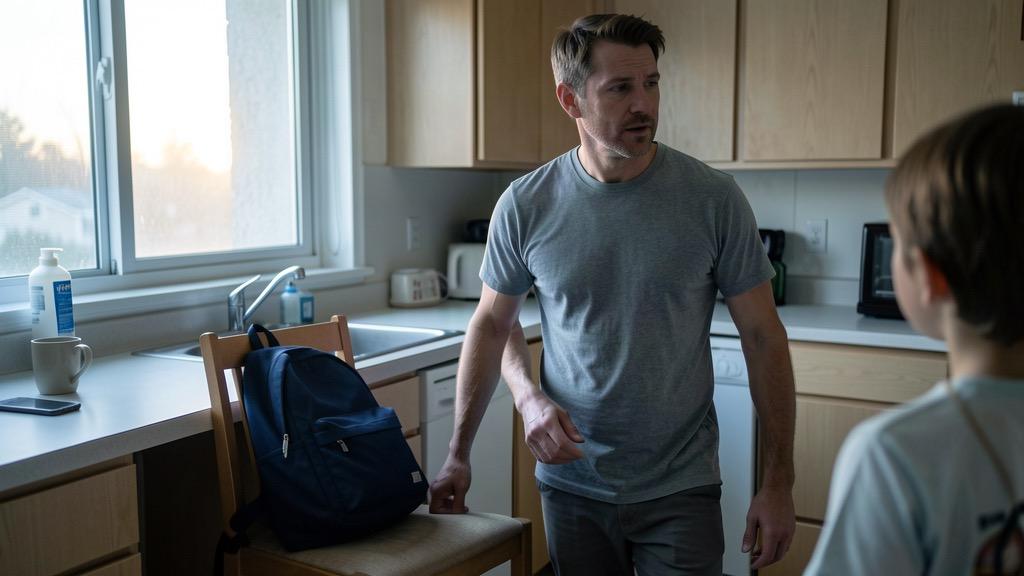
Cal had the card open before the backpack was zipped. A four minute strength workout after 65 was the line under the photo, and he had already decided it applied to him. He is 41. He lifts on Thursdays before the school line. The text under his thumb, still unsent, told his partner to skip the rack. Four minutes at the counter would cover it. He wanted me to bless the skip.
I'm Jake, 40, and I supervise day-shift hospital security. I went from 308 to 196 over 9.5 months starting mid-2025. I have used a short headline to get out of a session I had already agreed to. The scale moved when I stopped negotiating with tabs. It was not going to move because I blessed his.
Chiron had already done the boring part. The watch came in on Chiron's 4:10 a.m. check with five hours and forty minutes of sleep. That check cut one set off the press and left the session on the card. A voice note was queued for the car after drop-off, his name on it, asking whether the shoulder from Tuesday still barked. He had not opened any of that. You know that move. The headline is louder than the log.
Related Read
The Overdrive Tab Did Not Write ThursdayA November 18 ScienceDaily tab restamped an October 30 mouse note. Two treadmill days are not a Thursday skip.
A recirculated headline is not a new trial.
He stood up from the chair to prove it
He did not look up. "It says four minutes. If four minutes works after 65, it works for me, and I am late."
Then he did the thing the headline was selling. He stood up from the kitchen chair, sat, stood again, and looked at his kid like the kid was the stopwatch. Four stands. The kid said, "Are you okay." That was the whole study, performed badly, in the wrong house. He laughed, because he had to. The unsent text was still there.
That is the mistake, and it is his workout, not a chart. A magazine card looks like permission if you want Thursday to get smaller. I turned the phone. The article under his thumb was Men's Journal, 21 October 2026. The study it pointed at was not published last night.
The ScienceDaily page is dated 21 October 2026. The university release it reprints is dated 9 June 2026. Penn State published that release in June. The paper under both pages was accepted in February.
Dandekar and colleagues, PLOS One, 12 March 2026, volume 21, number 3, e0336748. Received 23 October 2025. Accepted 20 February 2026. Christopher Sciamanna is the senior author. Four movements, 30 seconds each, 30 seconds of rest, every day, for 12 weeks. Push-ups, chair stands, rows, stair stepping. They mailed bands and a stepper. Someone on video corrected the form at the start and again at weeks 2, 4, and 8. A daily email asked how hard it felt.
He tried to spend the result on the skip. Ninety-seven adults, 65 and older, already having trouble walking. Forty-four did the program. Fifty-three waited. The paper reports an average age of 74, and the Penn State release says they had been exercising about 18 minutes a week. Versus the people who waited, over 12 weeks, five-times sit-to-stand got 2.3 seconds faster (0.5 to 4.1, p = 0.01). One-legged stance got 3.6 seconds longer (0.6 to 6.5, p = 0.02). Chair stands in 30 seconds rose by 4.2 repetitions (2.8 to 5.7, p less than 0.001). They finished on 81 percent of days. ClinicalTrials.gov 05697497. The abstract says no significant adverse events. The paper body lists seven, in six people, all orthopedic. Shoulder discomfort was the most reported. One woman with shoulder pain was kept overnight to rule out a heart attack. That is why the voice note asks about Tuesday's shoulder before it asks about a magazine. Falls were not counted. A move into care was not counted. Sciamanna says those tests predict that future. The trial did not measure it.
4.2 extra chair stands is a result. It is not a permission slip.
Your dad's stairs are not your costume
Cal's dad is 76 and plans the week around the stairs at the house. That man is closer to this sample than Cal is. The false move is handing the dad the paper and also handing Cal a reason to ghost his partner. Two bodies. One headline. The skip is the product. The study is the excuse.
If you are 65 or older and walking is already hard, this page is still not your program. They had video coaching, mailed bands, and a daily email. Pain, a new limp, or a fall goes to the clinician who has seen you. I am not your doctor. If you are 40 and the session is already on the card, the trial asked a different question. It asked whether a very short home routine could move sit-to-stand in people who were barely training. It did not ask whether four minutes replaces a Thursday you already recover from.
The paper prints a conflict I am not going to bury and not going to inflate. Sciamanna is part-owner of BandUp, Inc. and Play Fitness, LLC. Another author consults for a drug company. Read the table, and do not turn a chair-stand result into a bottle. The effect sizes above are the paper's numbers. They still do not write your session.
He had the cheaper out ready. One short bout would handle the week, he said, and a counter push-up cannot make him late. That correction is already up: one workout is not the card. The cold-tub version of the same Thursday is also up: the ice bath did not close Thursday. Ten easy minutes and deeper sleep is a third page, and it is not this claim.
What stayed on his card while he watched the kid eat cereal:
- the cancel text stayed a draft
- 12 March stayed next to 21 October, so the tab cannot become the plan
- last night's plate stayed in the protein log, because a headline does not feed anybody
- his dad's stairs stayed his dad's problem
What the card will not import
A static app will congratulate you for reading a four-minute card before the badge is on. Chiron will not. Chiron's 4:10 a.m. check already shortened the press for the short night. It did not delete Thursday. The voice note in the car will ask about Tuesday's shoulder by name, because the paper's most reported complaint was a shoulder, not a skipped rack. It will not ask whether a magazine cleared you to vanish. HERMES keeps March next to October, and keeps 44 people who already struggle to walk next to one kitchen, so a text cannot promote the tab to your plan. If Thursday dies, the card shortens what is already written. It does not import a protocol that was mailed to a different age.
Sixty seconds of leg work, chair stands plus stair stepping, is not your Thursday.
He deleted the skip
He laughed once, the tired kind, and deleted the line where Thursday had to shrink because a magazine said four. "I wanted the skip more than I wanted the date." I know that want. I wore it at 308, and the scale did not care what I had open in a tab. He said he would do the session already on the card. He would send his dad the paper, not the headline, and let his dad's clinician decide if a four-minute floor belongs in that house. I said I know. That was the rescue. He zipped the backpack.
The phone will still congratulate you for opening a longevity tab before the shift. Decline it. The log keeps the session that was already planned. Send the cancel, and you have asked your partner to bless a study you were not in. Cal went to the car. The partner's reply was a time and a rack. That was plenty.
This page is not a prescription. If walking is already hard, or you are 65 and up and stairs are the week, take that to the clinician who has seen you. Pain or a new limp goes there. I am not your doctor. The authors studied older adults with mobility disability, not a healthy lift, and the headline on your feed is seven months younger than the paper.
The offer is $29.99 a month or $249.99 a year after a 7-day free trial. Cancel anytime. The free community argues the citation in public at Discord. The work lives at Legacy In Motion.
The Questions Readers Ask Most
Did a new study say four minutes a day replaces strength training?
No. Dandekar and colleagues published in PLOS One on 12 March 2026, volume 21, number 3, article e0336748. ScienceDaily recirculated the Penn State release on 21 October 2026. Men's Journal ran it that night. The trial is not from this week, and it did not test a general strength program.
Who was actually in the four-minute trial?
Adults 65 and older with pre-existing walking difficulty. Ninety-seven people were randomized, 44 to the four-minute program and 53 to a delayed-treatment control. The paper reports a mean age of 74. The Penn State release says about 18 minutes of exercise a week before the trial. That is not a 40-year-old who already lifts.
What did the four-minute program actually change?
Versus control over 12 weeks, the five-times sit-to-stand was 2.3 seconds faster (interval 0.5 to 4.1, p = 0.01), one-legged stance was 3.6 seconds longer (0.6 to 6.5, p = 0.02), and 30-second chair stands rose by 4.2 repetitions (2.8 to 5.7, p less than 0.001). They finished the workout on 81 percent of days. The abstract says no significant adverse events. The paper body lists seven, in six people, all orthopedic, shoulder discomfort most reported, and one overnight hold to rule out a heart attack. Falls and nursing-home admission were not measured.
Comments (0)
Comments are reserved for Legacy In Motion members.
$29.99/month. No contracts. Cancel anytime.
Get StartedAlready a member? Sign in
You read this far. Now do this.
Close the tab.
Go train the plan that fits your life.
I went from 308 to 196 lbs working 12-hour overnight shifts with two kids and zero personal trainer. The system I used is now an app that plans your training and meals around YOUR schedule — overnight, day shift, all of it.
Cancel anytime · No setup fee · No long contract
Free Assessment
Where's Your Training Stuck?
Take our 60-second quiz and get a personalized breakdown of what's stopping your progress — plus how AI coaching solves it.
Take the QuizFree PDF · No Credit Card
Download the Shift Worker AI Fitness Blueprint
The exact 4-week protocol Jake used to lose 112 lbs working hospital security overnights — sleep timing, the four-minute REHIT window, post-shift macros, and the AI deload trigger. Drops in your inbox in 30 seconds.
Built by someone who actually worked them. No fluff. Unsubscribe any time.
Keep Reading
2026-11-19
The Overdrive Tab Did Not Write Thursday
A November 18 ScienceDaily tab restamped an October 30 mouse note. Two treadmill days are not a Thursday skip.
2026-11-29
The Shortcut Tab Did Not Write Sunday
ScienceDaily stamped a shortcut to eating less on November 28. The trial averaged 14 percent across two years. A stamp is not a Sunday skip.
2026-11-23
The Brown Fat Tab Did Not Write Monday
A November 21 ScienceDaily tab restamped an October 14 Nature paper. Mice on losartan did not lose weight. Monday stays.
Join our free fitness community — get coaching tips, share wins, and stay accountable.
JOIN THE DISCORD →