


Liposomal Glutathione vs NAC: The Night-Shift Warehouse Problem
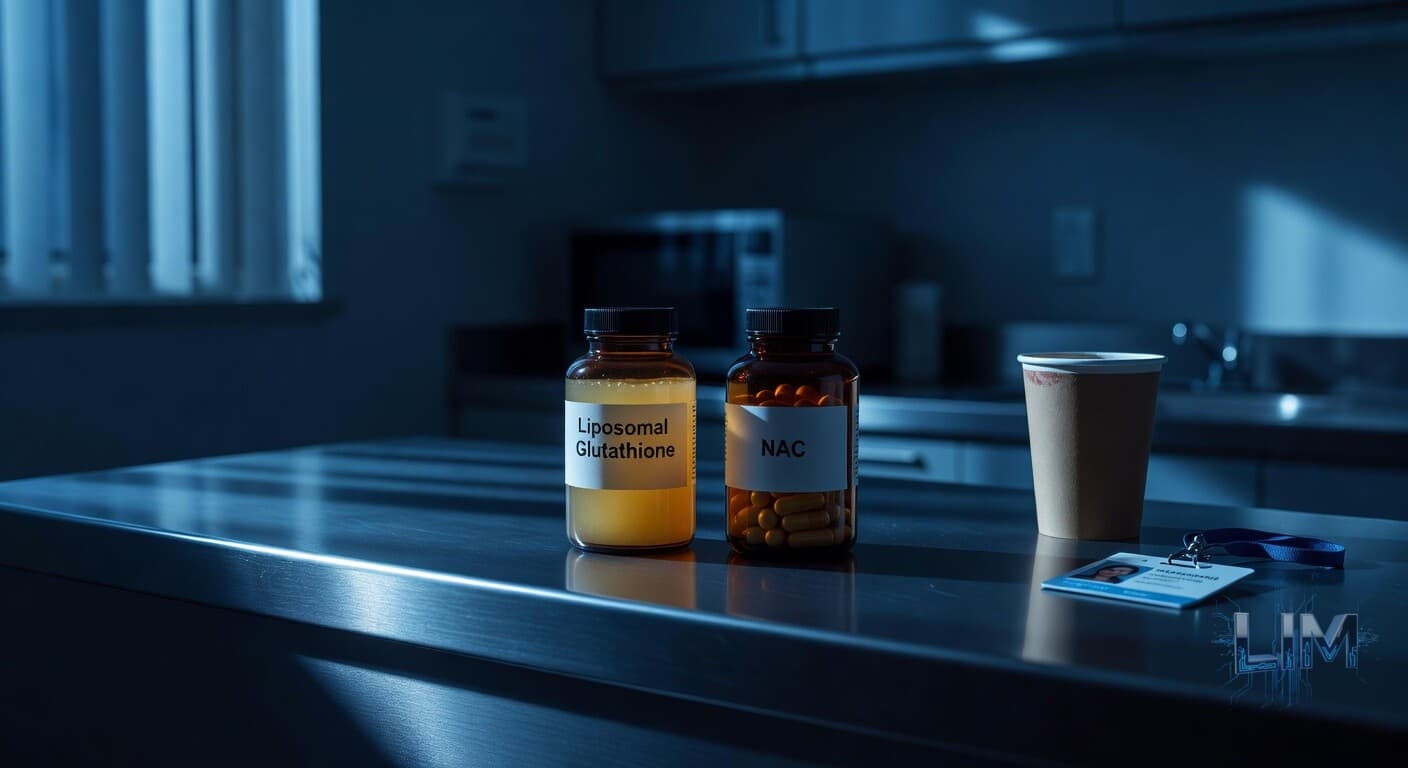
Sarah is 38. Charge nurse, ED night shift, three twelves a week. Single mom of two — a six and a nine. Her four "days off" disappear into pickups and laundry and a child who only sleeps when she does not.
She catches her face in the breakroom mirror at 04:11 on a Tuesday. The skin is the gray you only see at shift change under fluorescent lights. Her resting heart rate has crept up six beats since January. Her last labs flagged hsCRP. The drugstore magnesium and the gummy multivitamin she has been chewing for two years are not touching whatever is happening underneath.
This is the post she should have been handed eleven years ago.
TL;DR
- Bhatti 2017 found significantly elevated 8-OHdG (a DNA-damage marker) in night-shift workers versus day workers on identical jobs.
- Sinha 2018 dosed liposomal glutathione at 500 mg per day for four weeks: blood GSH up 40 percent, 8-OHdG down 20 percent.
- Richie 2015 dosed oral glutathione at 1,000 mg per day for six months: whole-body GSH stores up 30 to 35 percent across red blood cells, plasma, lymphocytes.
- NAC supplies the precursor; under chronic oxidative load the synthesis machinery itself is oxidized, so the precursor stalls.
- For circadian-disrupted physiology the evidence backs both compounds, used for different jobs.
The shift-work tax shows up at the nucleotide level
Bhatti and colleagues tracked urinary 8-hydroxy-2'-deoxyguanosine in night-shift workers. Same job sites, same patient load, significantly more oxidative DNA damage in the night crew.
Related Read
Night Shift Meal Timing: Why Breakfast After Nights FailsDelayed eating windows—not classic 16:8—improve next-day glucose handling for rotating nurses. Build a meal clock from your roster, not the wall clock.
The gap widened with each year on rotating schedules.
This is not a lifestyle inference. It is a biochemical fingerprint.
The IARC classified shift work involving circadian disruption as Group 2A — probable carcinogen — in 2007. The 8-OHdG signal Bhatti documented is one of the mechanisms behind that label.
Glutathione is the tripeptide your liver, your lungs, and every tissue use to neutralize the damage before it sticks to DNA. When GSH runs low, 8-OHdG climbs. The whole game is keeping the warehouse full.
NAC is the brick. Glutathione is the warehouse.
This is the distinction the supplement aisle gets wrong, and it matters for anyone already depleted.
N-acetylcysteine supplies cysteine, the rate-limiting amino acid for glutathione synthesis. In healthy, well-fed, well-rested adults, NAC at 600 to 1,200 mg per day raises intracellular GSH reliably. That part is true.
What gets skipped is the next step. NAC assumes the synthesis machinery is intact: adequate glycine and glutamate, functional gamma-glutamylcysteine synthetase, enough ATP to run two ligase steps.
Under chronic oxidative load, those assumptions fail. The machinery itself gets oxidized.
You can pour cysteine into a leaky system and watch GSH stay flat.
NAC is the brick. Glutathione is the warehouse. You can deliver bricks all day. If the warehouse is empty when the truck arrives, the bricks do not help.
Two trials closed the bioavailability argument
The historical objection to oral GSH was bioavailability. Gut peptidases shred the tripeptide before it reaches circulation. Two trials closed that argument.
Sinha and colleagues dosed liposomal glutathione at 500 mg per day for four weeks in healthy adults. Blood GSH rose 40 percent. 8-OHdG, the same marker Bhatti found elevated in night workers, dropped 20 percent.
Four weeks. Five hundred milligrams. The warehouse refilled.
Richie and colleagues ran the longer protocol — 1,000 mg of oral glutathione per day for six months. GSH stores rose 30 to 35 percent across red blood cells, plasma, and lymphocytes.
That is whole-body distribution, not a one-tissue spike. The lymphocyte number is the one that matters for Sarah, because lymphocytes run immune surveillance, and night workers are the most consistently immune-suppressed population in the occupational-medicine literature.
If you are already depleted, you want the warehouse refilled directly. Not a precursor that depends on intact synthesis.
Why shift work specifically breaks the precursor model
Three mechanisms drive the night-worker GSH gap. None of them are solved by piling more cysteine on the input side.
Suppressed melatonin during the active phase. Melatonin is a potent radical scavenger and a regulator of glutathione peroxidase activity. Light at 2 a.m. crashes it and strips a defense layer the day crew gets for free.
Mistimed feeding. A 3 a.m. meal drives postprandial reactive-oxygen-species production when hepatic glutathione cycling is at its circadian low. Synthesis enzymes follow a clock. Cysteine that arrives when the machinery is downregulated does not produce proportional output.
Chronic sleep debt. One restricted night measurably depletes glutathione in animal models and shifts the GSH:GSSG ratio toward the oxidized form in human plasma. The warehouse drains faster than the precursor refills it.
Stack those three across eleven years of rotating schedules and the precursor-only model collapses. You need the finished product.
The stack that actually refills it
For shift-disrupted physiology the evidence supports both compounds, used for different jobs.
Liposomal glutathione, 500 mg in the morning with a fat-containing meal. Sinha 2018 dosing. Direct warehouse loading. Take it before the shift, not after.
NAC, 600 to 1,200 mg later in the day. Complement, not replacement. You refill the warehouse directly and top up precursor for ongoing synthesis.
Magnesium glycinate, 300 to 400 mg at night. Cofactor for glutathione synthase. The glycinate form doubles as the third amino acid in the GSH tripeptide. Most shift workers are chronically low anyway.
Selenium, 100 to 200 mcg per day in the selenomethionine form. Glutathione peroxidase is a selenoenzyme. A full warehouse with no forklift operator does not move inventory.
Methylfolate 400 mcg plus methylcobalamin 500 mcg. The methylation cycle feeds homocysteine into the transsulfuration pathway and produces cysteine endogenously. Broken methylation upstream means cysteine shortage downstream, regardless of NAC dose.
Vitamin D3 5,000 IU with K2 (MK-7) 100 mcg. Dosed to keep 25(OH)D between 50 and 70 ng/mL. D regulates Nrf2, the master transcription factor for endogenous antioxidant enzyme expression.
What is not on the list: high-dose vitamin C megadoses, IV-push wellness-clinic upsells, the $600-a-month "master antioxidant" subscription. The trial data does not back any of them over the warehouse-and-cofactor stack above.
Implementation
Test 8-OHdG if you can run the panel. Track GSH:GSSG annually. If you are six months into shift work and your markers are drifting, the Sinha protocol is the highest-evidence intervention available short of changing your schedule.
Sarah has not changed her schedule. She rebuilt the stack around it.
Twelve weeks in, her resting heart rate dropped four beats. The hsCRP came down. The breakroom mirror at 04:11 looks like a person again.
For Sarah on year eleven, the question is not NAC or glutathione. It is whether to keep treating a warehouse problem with a brick delivery.
Fill the warehouse directly. If you want the daily program that watches your sleep window, the labs that drift, and the supplement timing against the actual shift you work, start the trial at legacyinmotion.fit.
---
The data behind this
- Bhatti P et al. 2017 (Occupational and Environmental Medicine) — significantly elevated urinary 8-OHdG in night-shift workers vs day workers on identical jobs; gap widens with years on rotation.
- Sinha R et al. 2018 (European Journal of Clinical Nutrition, n=12) — liposomal glutathione 500 mg/day for 4 weeks raised blood GSH 40 percent and dropped 8-OHdG 20 percent.
- Richie JP et al. 2015 (European Journal of Nutrition, n=54, 6 months) — oral glutathione 1,000 mg/day raised whole-body GSH stores 30 to 35 percent across red blood cells, plasma, and lymphocytes.
- IARC Monograph 2007 — shift work involving circadian disruption classified Group 2A (probable human carcinogen).
- Boyle NB et al. 2017 (Nutrients) — magnesium supplementation lowers cortisol under acute and chronic stress, with effect size tied to baseline depletion.
- Slutsky I et al. 2010 (Neuron) — L-threonate crosses the blood-brain barrier and raises CSF magnesium ~15 percent.
- Jake's n=1: 308 to 196 across 12-hour overnight hospital security shifts; the supplement layer was a contributor, not the lever — the foundation was protein, sleep, and progressive load.
---
Get Chiron in your pocket — $29.99/month
Start logging and Chiron, our AI head coach, starts adjusting: protein targets per meal, training volume after short sleep, a deload when your numbers call for it instead of when the calendar does. HERMES, our research engine, feeds new research into your coaching the morning it publishes.
$29.99/month · $249.99/year · 7-day free trial · cancel anytime · no enrollment fee · no contract
Start coaching → · See the full app →
Jake Long built it after losing 112 lbs working hospital night shifts — when no human coach could keep up with his schedule. He wanted the system he wished he'd had at 308. Now you can use it too.
Comments (0)
Comments are reserved for Legacy In Motion members.
$29.99/month. No contracts. Cancel anytime.
Get StartedAlready a member? Sign in
You read this far. Now do this.
Enough reading about it.
Time to train around the life you actually live.
I went from 308 to 196 lbs working 12-hour overnight shifts with two kids and zero personal trainer. The system I used is now an app that plans your training and meals around YOUR schedule — overnight, day shift, all of it.
Cancel anytime · No setup fee · No long contract
Free Assessment
Where's Your Training Stuck?
Take our 60-second quiz and get a personalized breakdown of what's stopping your progress — plus how AI coaching solves it.
Take the QuizFree PDF · No Credit Card
Your free Shift Worker AI Fitness Blueprint
A 4-week plan that respects what shift work does to sleep: when to go down after a night, the four-minute REHIT window, post-shift macros, and when to back off. In your inbox in 30 seconds.
Built by someone who actually worked them. No fluff. Unsubscribe any time.
Keep Reading
2026-07-21
Night Shift Meal Timing: Why Breakfast After Nights Fails
Delayed eating windows—not classic 16:8—improve next-day glucose handling for rotating nurses. Build a meal clock from your roster, not the wall clock.
2026-04-22
The Nurses Station at 02:00 Runs Fifteen Times Brighter Than the Study
A 31-lux eReader cut melatonin 55%. A hospital corridor at 02:00 runs ten to fifteen times that dose. The lens spec, dose, and timing that fix it.
2026-04-20
Magnesium for Night Shift Brains
Join our free fitness community — get coaching tips, share wins, and stay accountable.
JOIN THE DISCORD →