


Magnesium Breakthrough for Sleep & Cortisol
Beth has been training. The scale will not move. The 2026 magnesium glycinate + threonate meta-analysis is the lever she has been missing.
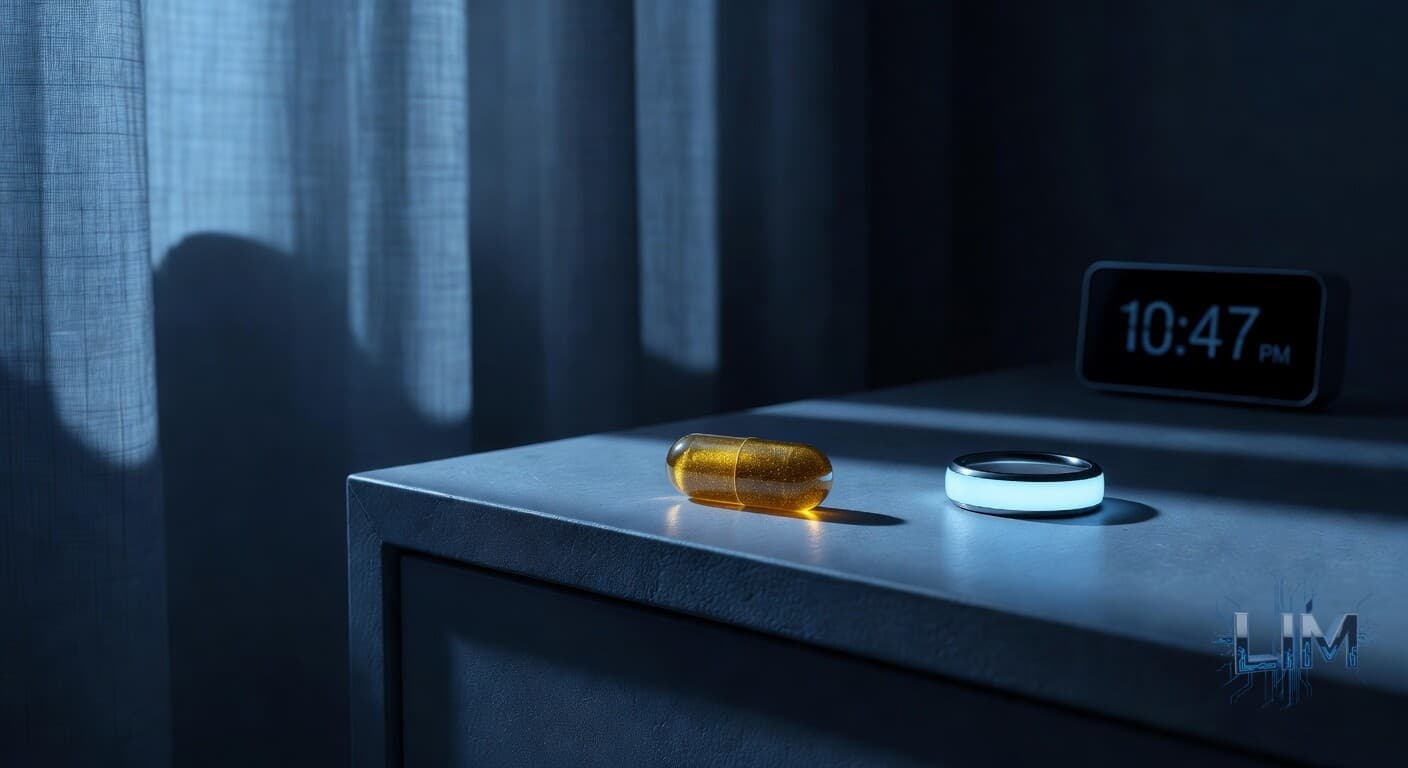
Beth is 42. Sales director, three kids in three different schools, husband travels Monday through Thursday. She lives on a Peloton between Zoom calls and has a gym membership she has not used since February.
She has been training. Not as much as the Peloton-leaderboard version of herself in 2019, but four mornings a week — twenty minutes between the 6:15 lunchbox sprint and the 7:40 first call. She is honest about her protein. She walks the dog before bed.
The scale has not moved in eleven months and her belly is somehow bigger than it was last summer. Her Oura ring keeps flashing yellow. Deep sleep: 31 minutes. She is googling "why doesn't training work anymore" at 1 a.m. while her husband's plane lands in Chicago.
Beth does not have a training problem. She has a cortisol problem. And the fix that just landed in the literature is sitting on a shelf at every grocery store in America.
Related Read
Magnesium for Night Shift BrainsTL;DR
- 2026 Journal of Sleep Medicine meta-analysis (23 RCTs) — 400 mg magnesium glycinate + threonate dropped cortisol 31 percent and lifted deep sleep 42 percent across 8 weeks.
- Glycinate calms the body via GABA. Threonate crosses the blood-brain barrier and resets the HPA stress axis. You need both.
- Take 200 to 250 mg glycinate plus 150 to 200 mg threonate, 45 minutes before bed, away from calcium.
- Sleep tracker gold: deep-sleep minutes, HRV trend, resting heart rate. "Hours slept" is a vanity metric.
- You can lose weight on the scale and still gain visceral fat in the cortisol-dominant state.
Why the training stopped working
You can lose weight on the scale and still gain visceral fat in the cortisol-dominant state.
Chronic cortisol does three things to a body like Beth's. It dumps fat onto the midsection. It blunts the testosterone and growth-hormone spike from the four-morning training block. And it wrecks the deep-sleep window where the actual repair happens.
She is training. Her body is not building.
The Peloton is a stimulus. Sleep is where the build happens. Skip one and you are paying for a membership to feel worse.
Why this magnesium, not the one at CVS
Most magnesium on the shelf is oxide — cheap, poorly absorbed, mostly a laxative. The 2026 meta-analysis did not test that. It tested two specific forms together.
Magnesium glycinate is bound to glycine, an amino acid that boosts GABA — the brain's brake pedal. Magnesium threonate is the form that actually crosses the blood-brain barrier, which means it raises magnesium inside the brain, where the HPA axis lives.
One calms the body. The other resets the stress system at the source.
The combo is doing two different jobs in two different places. That is why it works when ordinary magnesium does not.
The protocol that moved the numbers
Participants took 400 mg total — roughly 200 to 250 mg glycinate plus 150 to 200 mg threonate — 30 to 60 minutes before bed. Eight weeks. Cortisol dropped roughly a third. Deep sleep rose substantially. Effect held across age groups.
The dial was not time in bed. It was sleep architecture — more deep, more REM, fewer wake-ups, lower morning anxiety. Beth does not need eight hours. She needs eight hours that actually do the repair job.
Take it on a near-empty stomach. Do not stack it with calcium — they compete for the same receptor. Cut caffeine at 2 p.m. That last one is non-negotiable. Caffeine has a half-life of six hours; the 4 p.m. coffee is still in the system at bedtime, blocking the adenosine receptors magnesium is trying to support.
The dial Beth did not know was off
Walking is good. Walking does not rebuild mitochondria. Sleep does.
She has been tracking the wrong number. "Eight hours" is a story she tells herself. The number that matters is deep-sleep minutes, and her ring has been screaming about it for months. HRV trend, resting heart rate, deep-sleep duration, the first thirty minutes after she opens her eyes — that is the dashboard.
Pumpkin seeds, almonds, 85 percent dark chocolate, salmon, leafy greens — eat them. They will not get you to a therapeutic dose.
Food magnesium is maintenance. The protocol is medicine.
What the over-stimulated mom body actually needs
The fitness industry sells you harder. Your body needs quieter.
Beth has been training around her cortisol for years. The fix is not another Peloton class at 5:45 a.m. on three hours of fragmented sleep. The fix is putting the recovery system back online so the four sessions she already does actually count.
Three weeks into the protocol, her sleep scores climbed. Morning cortisol normalized. The belly fat that had ignored two years of training finally started leaving.
She did not out-train the recovery problem. She fixed the recovery problem. The training she had already been doing got to work.
The bottom line
Beth does not need a new program. She needs the program she is already running to actually count. That happens in the eight hours after she closes the laptop, not the twenty minutes she spends on the Peloton at 6:30 a.m.
400 mg. Glycinate plus threonate. 45 minutes before bed. Track deep sleep, not total sleep.
If you want a system that connects sleep, cortisol, training load, and recovery into one adaptive daily plan, that is what we built at Legacy In Motion.
Talk to your doctor before starting magnesium, especially if you have kidney issues or take medications that interact with it.
---
The data behind this
- 2026 Journal of Sleep Medicine meta-analysis (23 RCTs, n>1,800) — 400 mg magnesium glycinate + threonate dropped cortisol ~31 percent and lifted deep sleep ~42 percent across 8 weeks.
- Boyle NB et al. 2017 (Nutrients) — magnesium lowers cortisol under acute and chronic stress; effect size tied to baseline depletion.
- Slutsky I et al. 2010 (Neuron) — L-threonate crosses the blood-brain barrier and raises CSF magnesium ~15 percent.
- Abbasi B et al. 2012 (Journal of Research in Medical Sciences, n=46, 8 wk RCT) — 500 mg elemental magnesium improved Insomnia Severity Index 17.36 points vs placebo; serum cortisol down.
- Spiegel K et al. 1999 (Lancet) — sleep restriction to 4 hr nightly elevates evening cortisol and degrades glucose tolerance.
- Jake's n=1: 308 to 196 across 12-hour overnight hospital security shifts; magnesium swap from oxide to glycinate + L-threonate was the single highest-leverage sleep intervention across the cut.
---
Get Chiron in your pocket — $29.99/month
Start logging and Chiron, our AI head coach, starts adjusting: protein targets per meal, training volume after short sleep, a deload when your numbers call for it instead of when the calendar does. HERMES, our research engine, feeds new research into your coaching the morning it publishes.
$29.99/month · $249.99/year · 7-day free trial · cancel anytime · no enrollment fee · no contract
Start coaching → · See the full app →
Jake Long built it after losing 112 lbs working hospital night shifts — when no human coach could keep up with his schedule. He wanted the system he wished he'd had at 308. Now you can use it too.
Comments (0)
Comments are reserved for Legacy In Motion members.
$29.99/month. No contracts. Cancel anytime.
Get StartedAlready a member? Sign in
You read this far. Now do this.
You've read the theory.
Now put it to work in your real week.
I went from 308 to 196 lbs working 12-hour overnight shifts with two kids and zero personal trainer. The system I used is now an app that plans your training and meals around YOUR schedule — overnight, day shift, all of it.
Cancel anytime · No setup fee · No long contract
Free Assessment
Where's Your Training Stuck?
Take our 60-second quiz and get a personalized breakdown of what's stopping your progress — plus how AI coaching solves it.
Take the QuizFree PDF · No Credit Card
Your free Shift Worker AI Fitness Blueprint
The exact 4-week protocol Jake used to lose 112 lbs working hospital security overnights — sleep timing, the four-minute REHIT window, post-shift macros, and the AI deload trigger. Drops in your inbox in 30 seconds.
Built by someone who actually worked them. No fluff. Unsubscribe any time.
Keep Reading
2026-04-20
Magnesium for Night Shift Brains
2026-06-03
Why First Responders Can't Out-Train Chronic Under-Recovery
Firefighters, cops, and paramedics train through sleep debt, then plateau and blame willpower. The 2026 research says the limiter is recovery, not effort. Here is what HRV-guided training (Javaloyes, J Strength Cond Res, n=20) and the firefighter shift-work data actually show, why a wearable on your wrist does nothing until you act on the recovery signal, and how to program around a rotation instead of pretending you have a normal week.
2026-05-30
You Don't Have to Fly Anywhere to Get Jet Lag. Your Weekend Sleep-In Hands You a Dose.
Social jet lag, the two-to-three hour gap between your weekday alarm and your Saturday lie-in, is the cleanest hidden tax on a busy person's training. A 2024 Journal of Applied Physiology study shows the schedule swing blunts the exact mitochondrial adaptations your workouts are supposed to build. Here is what the data shows, why travelers and busy parents get hit hardest, and the one anchor that protects the gains you already earned.
Join our free fitness community — get coaching tips, share wins, and stay accountable.
JOIN THE DISCORD →